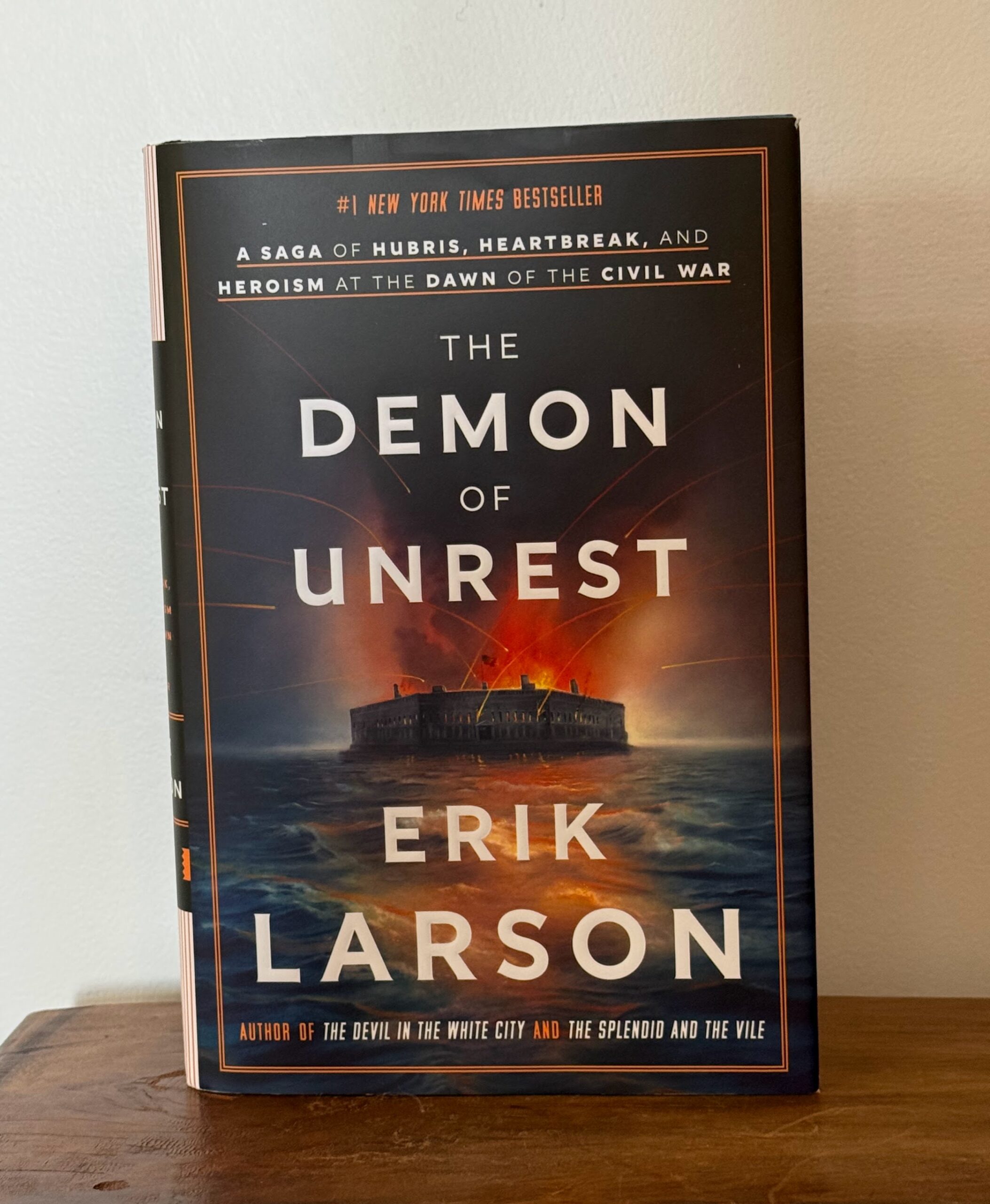
The Demon of Unrest, published in 2024, covers the period from 1860 to the firing on Fort Sumter in 1861, the event that set off the Civil War. Larson is one of my favorite authors; I’ve also read The Splendid and the Vile and The Devil in the White City, both of which I loved. I even got to hear him speak at a book festival, and listening to him talk about his writing process made me appreciate his work even more.
After reading The Splendid and the Vile, I was really expecting Larson to bring that same narrative energy to this pivotal moment in American history. Instead, even though the research is obviously deep, I found the book surprisingly slow.
The book covers the period from Abraham Lincoln’s election in November 1860 to the Confederate attack on Fort Sumter in April 1861. One of its strengths is that it underscores how central slavery was to the crisis, challenging the simplified version of history many of us were taught. At the same time, although Larson brings forward figures such as Lincoln, Major Anderson, and Mary Chestnut, I often felt he did not stay with them long enough to create the kind of close narrative connection that makes his best work so compelling.
Reading this book alongside works such as Plain, Honest Men and Miracle at Philadelphia highlights how deeply slavery shaped the nation’s political compromises from the beginning. Larson’s account reinforces that the conflict was not simply about abstract regional differences, but about an economy and social order built on the buying and selling of human beings. That historical reality gives the book moral weight, even when the storytelling itself loses momentum.
The book also suggests that Lincoln and his advisers underestimated the depth of Southern hostility and the speed with which the crisis would turn into war. Given the limits of communication at the time, that miscalculation is understandable, but Larson’s broader portrait shows how fragile the Union had become. The human cost that followed was staggering hundreds of thousands of deaths, countless injuries, and immense suffering caused not only by combat, but also by disease and poor camp conditions. That knowledge gives the events at Fort Sumter a tragic immediacy.
When I heard Larson speak at a book festival, he talked about how carefully he works to build suspense out of historical material, and that’s something I’ve always admired in his writing. You can see that effort here too, but this time the detail often felt excessive rather than immersive. The research is clearly extensive, drawing on diaries, letters, and other sources, but for me it didn’t always come alive in the way I expected. For long stretches, the book felt more like a traditional history than the gripping narrative I associate with Larson at his best.
My biggest issue was the pacing. In books like The Splendid and the Vile, Larson usually finds a strong balance between historical scope and intimate human detail, and that’s what keeps the story moving. Here, that balance shows up too late. Its only once Fort Sumter becomes the central focus that the book finally develops the urgency and tension I had been waiting for.
Larson mentions in his acknowledgments that his wife, one of his first readers, urged him to cut quite a bit from the manuscript*. I must admit, that stood out to me. The book feels overlong, and I think it would have been stronger if it had stayed more tightly focused on a smaller set of central figures. For readers who are deeply into Civil War history, that level of detail may be a plus; for others, it may just feel like too much.
To be fair, the book becomes more engaging when Larson narrows his attention to individual personalities and to the moral and political arguments surrounding slavery. Those sections show the strengths that have made him such a successful writer. For committed Civil War readers, this may be an essential account. For general readers, however, there are likely other histories and biographies that provide a more consistently absorbing introduction to the period.
In the end, I still admire Larson’s ambition, his research, and the seriousness he brings to this painful chapter of American history. The subject matter is important, and the themes feel especially relevant right now, when political division once again seems so pronounced. Still, I had a hard time recommending the book without hesitation. Readers already steeped in Civil War history may get a great deal out of it, but for many others, the length and pacing may make it a tougher read than it needed to be.
*”As always I owe big thanks to my wife, Chris, for her careful reading of my initial draft and her invaluable margin notes, consisting mainly of smiley faces, sad faces, and long lines of zzzzzzz’s.”
Some fun and interesting tidbits about The Civil War
- Did you know that the word sideburns came from General Burnside? One day I was in a coffee shop in the late 90’s in Philadelphia. The answer won me a free muffin in a trivia game about the Civil War.
- Even though she was a Confederate informant, Belle Boyd spied on the Yankee soldiers by cajoling them into her bed. Upon finding out the Yankees position she shared her intel with the Confederate Army.
- As you approach Stonewall Jackson’s grave it reads: There he stood like a great stone wall. Apparently the great General suffered from dyspepsia which in modern terminology is Acid Reflux or more commonly heartburn. In those days the cure was to suck on lemons because they didn’t have over-the-counter medications like Tums, Zantac, or Antacids. In hushed reverence his grave was piled with lemons.


Leave a Reply